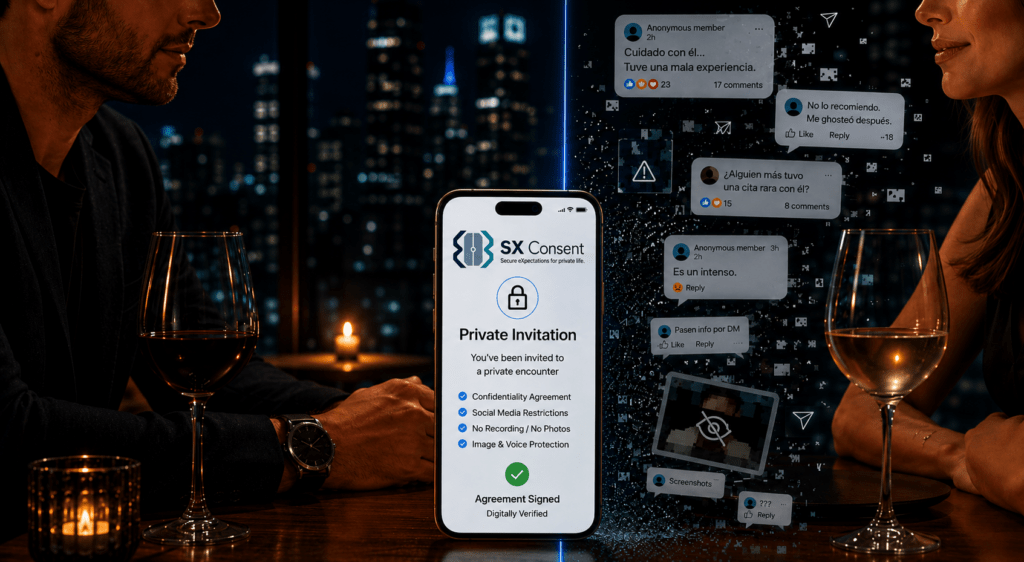
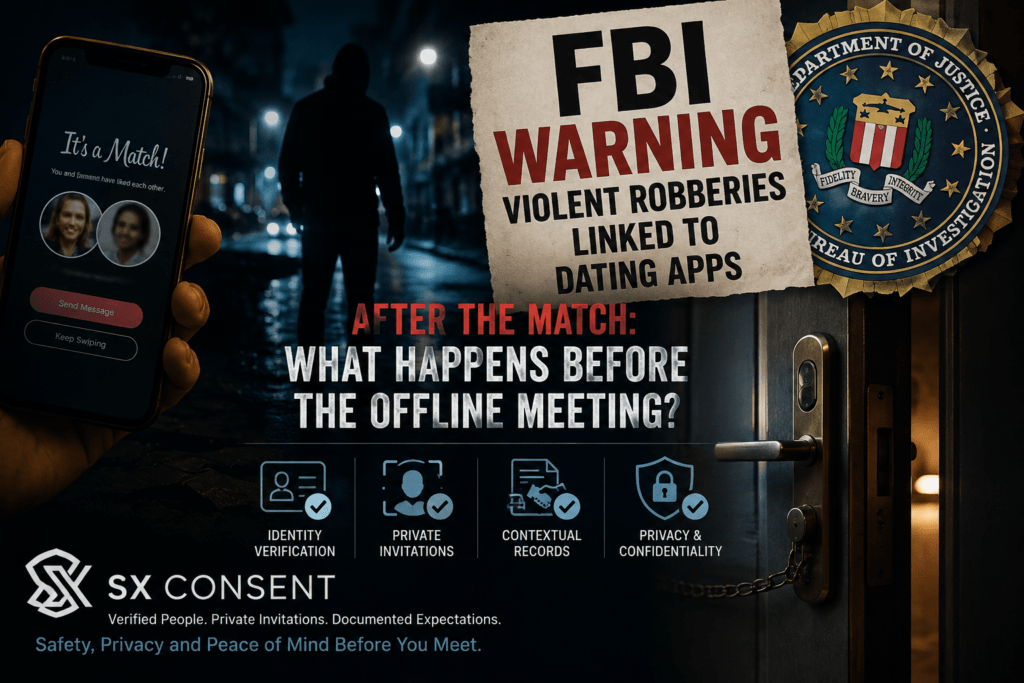
The FBI’s Miami Field Office warned that criminals are posing as legitimate romantic interests to arrange private meetups and rob their victims. The threat joins catfishing, scams, unauthorized recordings and reputational exposure in turning the transition from meeting someone online to seeing them in person into a new zone of risk. SX Consent is positioning itself precisely at that point: verified identity, private invitations, confidentiality agreements and a contextual record before the door ever opens.
MIAMI, Florida — August 29, 2026. What begins with a photograph, a conversation and the promise of a date can end at gunpoint.
On July 9, the FBI’s Miami Field Office warned South Florida residents about an increase in dating app robberies. According to the agency, offenders pose as legitimate romantic interests, contact victims through those platforms and arrange private meetups. In at least one incident described by the FBI, a suspect displayed a firearm, took the victim’s money and belongings, and then forced the victim to withdraw additional cash from an ATM.
The warning was reported by NBC 6 South Florida, Telemundo 51 Miami, Local 10 and later by Noticiero Univision. The latter described a pattern in which criminals create fake profiles, gain users’ trust and arrange meetings that end in armed robberies or assaults.
The FBI has not publicly disclosed the total number of cases behind the increase, nor has it identified the victims. That makes it impossible, for now, to measure the full scope of the criminal pattern. But the warning points to a disturbing evolution: the fabrication of a romantic identity — long associated primarily with financial fraud — can also be used to physically lure someone into a violent situation.
Adam Berry, Assistant Special Agent in Charge of FBI Miami, explained when announcing the warning that a criminal posing as a legitimate romantic interest can exploit someone who is genuinely seeking a relationship. The agency advised users not to disclose financial or personally identifiable information, to be wary of unverified profiles and to meet initially in safe locations.
The danger no longer ends at the screen.
It can now cross the threshold.
FBI Dating App Robberies: When Catfishing Stops Being Just a Lie
For years, catfishing was understood primarily as a form of digital deception: stolen photographs, fabricated biographies, nonexistent jobs and people who were never who they claimed to be.
The FBI has long documented how false identities are used to build emotional relationships and extract money. In 2025, the Internet Crime Complaint Center recorded approximately $929.3 million in losses associated with confidence/romance fraud, up from $672 million in 2024.
But the Miami cases represent a qualitative shift.
This is not necessarily about persuading someone to send money from the safety of a couch.
It is about getting that person to show up.
Dating App Safety: Digital Familiarity Is Not Identity
A prolonged conversation can create a powerful illusion.
Someone knows the other person’s face. They have seen photographs. They may know a username, an Instagram account, a phone number or may even have spoken over video.
That creates familiarity.
But familiarity and verifiable identity are not the same thing.
The distinction becomes far more consequential when the interaction leaves the phone and moves into a home, a vehicle, a hotel or any other setting where a person becomes physically exposed.
Pew Research Center found that 52% of people who have used online dating services believe they encountered someone who was trying to scam them. Another 48% reported experiencing at least one of four unwanted behaviors examined by the organization.
It is precisely at that point — after meeting someone digitally but before meeting offline — that a new platform called SX Consent is attempting to position itself.
For One of Its Creators, the Problem Did Not Begin in a Boardroom
For Samuel Beníquez, co-creator of SX Consent, the concern ultimately built into the product is also deeply personal.
For years, Beníquez was at the center of a highly public paternity dispute involving Teófilo Vargas Seín, known as Aarón, then the spiritual leader of the Congregación Mita. The litigation reached the Puerto Rico Supreme Court, which intervened in the legal controversy in 2012; a genetic test later confirmed biological paternity in 2013. The dispute received extensive coverage in the Puerto Rican press. (Puerto Rico Judiciary)
Beníquez says that during that period of his life, he also experienced episodes of harassment and surveillance that profoundly affected the way he approached strangers. Years later, when he was single and using dating apps, those earlier experiences turned encounters that might have seemed routine to others into decisions made with heightened caution.
“For me, this is not a theoretical concern. Before I married Alexander, I met people through dating apps and went through experiences that taught me how vulnerable a person can be when, behind a photograph and a conversation, there is still so much that has not been verified,” Beníquez said. “I was already coming out of extremely difficult years involving a highly public family controversy and episodes of harassment and surveillance that, in my experience, sometimes reached the point where police intervention became necessary. So I understand what it means to ask yourself who is really behind the person trying to enter your private life.”
The experience, he said, influenced how the founders ultimately defined the problem SX Consent needed to address.
“If a tool like SX Consent had existed at the time, it would not have eliminated every risk, and it could not have told me what another person’s intentions were. No technology can do that. But it would have given me something I did not have then: a layer of identity verification and traceability before deciding to meet that person,” Beníquez said. “Today, anyone participating in an SX Consent invitation has to go through a verification process designed to establish identity and adult status, validate documentation and identity through processes such as selfie and liveness checks, verify a phone number and email address, and associate certain technical and security information with the account. The difference is significant: before opening your private life to someone, you are no longer relying solely on a photograph, a username or whatever that person chose to tell you.”
SX Consent’s current documentation supports that general architecture. The platform requires identity and adult verification, as well as phone and email verification, before users can access its private functions. Its identity providers may perform checks involving government-issued documents, document authenticity, selfie and liveness verification, name and date-of-birth matching and antifraud signals. Its policies also contemplate IP information, device identifiers and security metadata.
SX Consent, however, expressly warns that no verification system can guarantee the detection of a dangerous user.
That limitation is fundamental.
Verifying someone does not certify their character.
It reduces one layer of uncertainty.
SX Consent Does Not Seek the Match; It Begins After It
SX Consent does not operate like Tinder, Bumble or Hinge.
It does not offer public profiles, swiping, public matching, social feeds or open searches for people. To send an invitation, a user must already know the other person’s phone number or email address outside the platform.
Dating apps are primarily designed to answer one question: Who can I meet?
SX Consent attempts to intervene when the question becomes:
Who is this person I have already decided to meet — and what have we agreed to before doing so?
The company’s website states that both the sender and recipient of an invitation operate within a system reserved for verified users. Before an agreement is generated, participants can review private requirements, confidentiality expectations, preparation details, location context when applicable and conditions specific to that invitation.
The Idea Began With a Photograph — and What It Can Reveal
Alexander Sánchez, co-creator of SX Consent and an advertising professional by trade, traces the conceptual origin of the platform to a different kind of exposure.
Over the years, he says, he watched people in his social and professional circles suffer serious consequences after meeting strangers through digital platforms: extortion attempts, blackmail, threats of publication and reputational harm.
For Sánchez, the fundamental technological shift is that a user does not necessarily enter a conversation knowing nothing about the person on the other side.
The opposite may be true.
“The idea for SX Consent began when I understood that the modern risk is not only that you may not know who the other person is. The problem can also be that the other person already knows a great deal about you before sending the first message,” Sánchez explained. “As an advertising professional, I have seen how vulnerable someone’s reputation can become when a private interaction turns into screenshots, threats, extortion, blackmail or social-media content.”
A single public photograph can become a starting point. Reverse-image search tools and other open-source intelligence techniques can connect photographs to social-media accounts, corporate pages, professional profiles and other publicly available traces.
That profoundly changes the symmetry of a first conversation.
“Today, someone can find your photograph on a dating app and use it to try to locate your social-media accounts, LinkedIn profile, profession, company, social circle and other public traces before they even introduce themselves,” Sánchez said. “For someone with bad intentions, that information can become intelligence: who you are, what kind of reputation you have, what you stand to lose and where your vulnerabilities may be. You may believe you are beginning a conversation between two strangers while the other person arrives with an enormous informational advantage.”
It was that asymmetry, Sánchez says, that led them to envision a different system.
“SX Consent was created to introduce friction before a digital connection turns into real-world access. We cannot certify human intentions, but we can require a common standard: if you are going to send me or receive from me a private invitation through SX Consent, both of us have already gone through the same account-readiness and verification process required by the platform,” Sánchez said. “That changes the equation. The interaction no longer begins simply with, ‘Trust what my profile says.’ It begins with an identity that has passed through verification controls and a specific invitation linked to identifiable users.”
That distinction is consistent with the design philosophy Sánchez had previously articulated for the company: privacy not as an assumption, but as something that can be intentionally structured before a private interaction.
In earlier SX Consent statements, Sánchez summarized that view by noting that a photograph, a screenshot, a recording or a conversation taken out of context can transform how a person is perceived within seconds.
A Private Invitation Before Opening the Door
SX Consent’s website describes an eight-stage process, beginning with verification and account readiness and continuing through closure and record preservation.
Before a meeting, participants can review privacy expectations, meeting conditions, location context when applicable and confidentiality terms; they then sign an agreement specific to that invitation.
That contract is perhaps the platform’s most unusual feature.
The current version establishes reciprocal obligations involving confidentiality, non-disclosure, non-disparagement, social-media posting, photographs, recordings, devices, image, voice, location and other matters related to privacy and preservation of context.
In other words, SX Consent does not address only the risk that the person behind a profile may be fake.
It also attempts to confront another modern threat:
What happens if the person is real, but later turns a private experience into public content?
From a Gun to a Screenshot: Different Risks, the Same Point of Entry
The robberies described by the FBI and digital defamation are legally distinct phenomena.
Armed robbery is a crime.
A false publication may constitute defamation depending on its content and the law that applies.
A photograph, an opinion or a subjective account can cause reputational harm without necessarily being unlawful.
And a breach of confidentiality may give rise to a different contractual theory.
Yet all share one operational characteristic: access.
Access to a person.
To their identity.
To their home.
To their routine.
To their conversations.
To their image.
To their family.
To their business.
To information that was previously beyond a stranger’s reach.
SX Consent attempts to turn that moment of access into a deliberate process rather than an implicit one.
The Other Crisis: When a Private Experience Becomes a Public Reputation
The fear is not limited to scammers and criminals.
Dating apps now coexist with a second digital infrastructure: communities that allow users to investigate, warn others about or exchange information on people before or after a date.
One of the most visible examples was Tea, an app designed for women to share information and warnings about men. Its growth demonstrated that there is a genuine demand for protective tools.
Then came the other side of the equation.
In 2025, Tea suffered a security breach that exposed tens of thousands of images, including photographs used in identity-verification processes.
The paradox was difficult to ignore: an infrastructure built around safety had itself accumulated exceptionally sensitive information.
The discussion demands balance.
Warning networks did not emerge from nowhere. There are documented risks involving harassment, fraud, threats and violence.
But acknowledging that need does not mean that a false accusation, an unauthorized publication of a private photograph or a fabricated story ceases to cause harm.
That is precisely where the tension lies:
How do we protect someone who has a legitimate need to warn others about danger without normalizing a system in which any private experience can automatically become public content about another person?
Changing the Legal Question Before the Post Appears
SX Consent also attempts to intervene at that point.
If a person relies solely on a defamation claim after something has already been published, the dispute may begin with the question of whether the publication constitutes an actionable false statement of fact.
A bilateral confidentiality agreement can add another question:
Did the publication, photograph, recording or disclosure violate a contractual obligation that had already been accepted?
Those are different legal theories.
SX Consent’s documentation contemplates electronic signatures, timestamps, contract versions, hashes, metadata and records intended to help establish who accepted particular terms and when.
The distinction may sound technical.
It is not.
Without a document, a dispute may begin with the question:
“What did we say?”
With a signed agreement, another foundation exists:
“What did we agree to?”
Protecting Privacy Without Silencing Crime
There is also an indispensable boundary.
An agreement intended to protect privacy and reputation cannot become a mechanism for preventing reports of violence, blocking cooperation with law enforcement, obstructing justice or eliminating rights the law considers nonwaivable.
SX Consent publicly states that it does not provide legal immunity, does not function as an emergency service and does not eliminate all risks inherent in real-world interactions. It also prohibits the platform from being used to pressure, silence, threaten or prevent someone from leaving or ending their own participation.
That places the proposition on considerably narrower ground than the phrase “legal shield” might suggest.
SX Consent can establish a private architecture for confidentiality and documentation.
It cannot replace criminal law.
It cannot replace the police.
It cannot determine someone’s character.
What the FBI Recommends — and What No App Should Replace
The Miami warning remains, above all else, a public-safety warning.
The FBI recommends initially meeting in safe locations, maintaining situational awareness, avoiding disclosure of financial or personally identifiable information and exercising heightened caution with unverified profiles.
SX Consent does not replace those measures.
Nor does it automatically make a private meeting safe.
Its potential utility exists at another layer:
Verify first.
Link identities.
Establish expectations.
Document the invitation.
Create traceability.
Preserve context.
And allow a person to make an informed decision before opening a private space.
The Gap Dating Apps Left Behind
For more than a decade, the online-dating industry refined one question:
How do we get two strangers to meet?
Algorithms.
Swiping.
Matching.
Messaging.
Compatibility.
Video.
Geolocation.
The FBI has now underscored a different, more uncomfortable question:
What happens after the match?
When the profile stops being a screen.
When the conversation becomes an address.
When someone gets into a car.
When they arrive at the building.
When the doorbell rings.
When the door opens.
That space — between the digital connection and the physical encounter — remains considerably less structured.
SX Consent is betting that a new category exists there: a private trust infrastructure for verified adults, built not around finding people, but around verifying, documenting and establishing rules before exposing oneself to them.
The FBI warning does not prove that SX Consent can prevent a robbery.
Defamation cases do not prove that a contract can control everything another person does afterward.
And no technology can determine with certainty the intentions concealed behind an attractive photograph and a convincing conversation.
But catfishing, scams, violence and reputational exposure converge at the same vulnerable moment:
when someone decides to trust.
For years, one question seemed sufficient:
“Where should we meet?”
In an era when a profile can be fake, a date can become an ambush and a private experience can turn into globally distributed content within seconds, perhaps that question is no longer enough.
Perhaps there are now three:
Who are you, really?
What have we agreed to?
And what will remain private when this encounter is over?
SX Consent is a private-invitation, confidentiality, privacy and contextual-records platform for verified adults. Learn how identity verification, private invitations and documented expectations work before an offline meeting.
Click here and Explore SX Consent