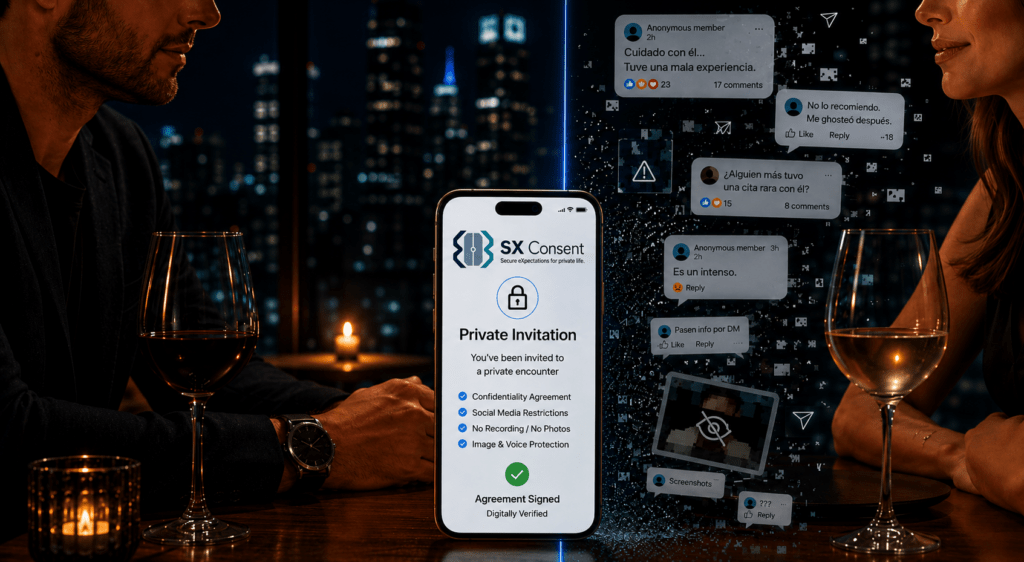
SAN JUAN, Puerto Rico — August 17, 2026. For decades, asking for a confidentiality agreement before opening the door to a residence, sharing sensitive information, or allowing access to one’s private life was a practice associated with celebrities, businesspeople, politicians, and people surrounded by lawyers. In 2026, that logic is beginning to move onto mobile phones and into everyday life. SX Consent, a platform developed for verified adults, proposes that two people who already know each other — even after initially meeting through a dating app — can establish written rules regarding privacy, confidentiality, posts, devices, and recordings before meeting offline. The app does not help people find partners. It does not offer public profiles, swiping, matching, user searches, a social feed, or a marketplace for encounters. Its point of entry comes afterward: when one person already knows another person’s phone number or email address and wants to extend a private invitation. The current Google Play listing describes that process as a system for creating invitations tied to a specific time, place, and context, reviewing expectations in advance, and later preserving a record containing signatures, timestamps, hashes, participant statuses, and closure responses.
That design places SX Consent at a commercially underexplored intersection: personal privacy, digital reputation, verified identity, and contract law. The company’s own market research acknowledges that no equivalent mass-market category yet exists and defines the opportunity as a “private-life trust utility” aimed at the space left uncovered by dating apps: what happens before, during, and after an offline meeting.
The question SX Consent seeks to answer is profoundly contemporary: what happens when a private experience can become permanent public content within minutes?
From the “Match” to the Contract: Dating Privacy and NDAs
Three in ten American adults have used a dating platform at some point, according to Pew Research Center. Among those who have used these services, 38% reported receiving unsolicited sexually explicit messages or images; 30% said they experienced persistent contact after expressing disinterest; 24% received insults; and 6% received threats of physical harm. Negative experiences affect young women particularly intensely.
That context helps explain why digital communities emerged to investigate strangers before meeting them: first private Facebook groups, then specialized platforms and, more recently, apps capable of turning millions of individual experiences into social databases about potential dates.
But that protective infrastructure produced a parallel consequence. The same technology that allows people to warn others about a dangerous person can also amplify a rumor, a subjective interpretation, a photograph, an unverified accusation, or an incomplete story.
This is where what might be called the contractualization of intimacy begins.
There is not enough evidence to claim that NDAs before a date are already a widespread practice among ordinary Americans. There is, however, an emerging market for tools that bring confidentiality agreements into the personal sphere. DocuSign published a specific explanation about NDAs in relationships in January 2026; apps such as Shush openly market themselves as mechanisms for creating confidentiality agreements related to dating and private life.
SX Consent takes that logic considerably further.
An Agreement Before the Door Opens: Privacy, NDAs and Digital Records
At the center of SX Consent is an 81-page Personal Privacy, Reputation Preservation, Confidentiality, and Private-Context Record Agreement, in its version 3.1. The document establishes reciprocal obligations regarding confidentiality, non-disclosure, non-disparagement, social media posts, photographs, recordings, devices, image, likeness, voice, location, forensic preservation, and private dispute resolution.
The structure is deliberately different from a simple verbal promise.
The agreement may incorporate participant identification, verified-adult status, execution data, timestamps, signature method, device metadata, IP address, agreement identifiers, hashes, and electronic certificates. According to the contractual document, those elements may later be used to establish who signed, when they signed, which version they accepted, and what the status of the agreement was at that time.
That does not mean the app can prove what physically happened during an encounter. Nor does it mean that a court will automatically admit its records. SX Consent’s own public terms expressly state that its records are contextual, “not absolute proof,” do not constitute legal conclusions, do not guarantee admissibility, and do not guarantee any judicial outcome. The practical difference is narrower, but also more concrete: if a dispute later arises over whether a confidentiality commitment existed, the controversy does not necessarily begin from zero.
There is an identifiable contractual version.
There is a record of acceptance.
And there is a contractual obligation independent of the later discussion over defamation.
From a Post to $100,000: SX Consent’s Liquidated-Damages Clause
The provision likely to attract the greatest legal attention is identified as “Escalating Liquidated Damages for Eligible Privacy and Reputation Breaches.”
The contract explains its rationale this way:
“Because actual damages may be impracticable or extremely difficult to determine and because reputational harm may spread before ordinary litigation can stop it, the Parties agree that the following amounts are reasonable pre-estimates of anticipated harm for eligible privacy, confidentiality, reputation, device, recording, social-media, image, likeness, voice, location, and evidence-integrity breaches.”
Among other examples, the contractual table assigns $100,000.00 for an unauthorized photograph involving a party, residence, private space, vehicle, license plate, confidential location, or element that allows the private context to be identified. It also establishes $100,000.00 for certain defamatory, malicious, misleading, humiliating, ridiculing, doxxing, or reputationally harmful posts, according to the units of measurement specified in the agreement.
For audio recordings, video, livestreams, transcripts, voice cloning, or certain unauthorized audiovisual files, the contractual amount rises to $250,000.00. And for the sale, licensing, monetization, media pitching, blackmail, extortion, paid leaks, paid interviews, or commercial exploitation of confidential information, the stipulated amount reaches $500,000.00 per eligible event, under the measurement rules established in the document.
Those amounts should not be confused with government-imposed fines or money that is automatically collectible.
They are contractual liquidated damages whose enforceability will depend on applicable law, the specific circumstances, the language used, and the analysis of the court or arbitrator. The agreement itself acknowledges that risk: it states that the amounts are intended to approximate anticipated damages rather than punish, and asks an adjudicator to reduce, reform, or sever an application deemed excessive rather than invalidate the entire structure.
That detail is fundamental. SX Consent can create a contractual architecture. It cannot guarantee that every clause will survive a legal challenge intact.
Tea App: When a Safety Network Becomes a Reputation Database
The context that makes this architecture especially relevant has a name: Tea.
Tea Dating Advice was not born in 2026; it launched earlier and exploded in popularity during 2025. It allowed women to anonymously post information and warnings about men they had met or were considering meeting. In July 2025, it reached the No. 1 position among free Apple apps in the United States. Tea claimed to have reached four million female users and, in a single week, its downloads increased 525%, according to data cited by the Associated Press.
For its supporters, Tea addressed a genuine problem: women trying to determine whether a profile concealed a history of violence, deception, catfishing, or other warning signs. For its critics, it turned human beings into review pages where photographs, accusations, and opinions could circulate before massive audiences without the man being discussed initially having an equivalent way to respond. Attorney Aaron Minc, who specializes in digital defamation, told AP that his firm had received hundreds of calls related to Tea within a matter of weeks. Then came the more serious irony: a platform built around safety and privacy suffered a series of breaches that exposed information belonging to its own users.
Tea initially confirmed access to approximately 72,000 images, including about 13,000 selfies or documents used for verification and another 59,000 images from posts, comments, and messages. A second exposure affected messages belonging to approximately 1.1 million users, according to WIRED. Tea and its male counterpart, TeaOnHer, ultimately disappeared from Apple’s App Store following controversies involving privacy and moderation. Tea returned in 2026 through a new web platform and remained available on Android.
The breaches also led to privacy and data-security litigation; WIRED reported ten potential class-action lawsuits. It is important to distinguish those cases from defamation litigation: there is no rigorous national statistic that would support the claim that Tea, by itself, caused a quantifiable increase in defamation lawsuits. What is documented is increasing legal activity surrounding reputation-related posts: legal analyses have identified multiple cases originating in Michigan, while litigation in North Carolina against Tea reached the appellate process in 2026 after a dismissal based on federal protections for platforms.
The distinction matters because panic should not replace evidence.
Chicago: “Are We Dating the Same Guy?” and the Limits of Defamation Law
Long before Tea’s rise, the Facebook groups “Are We Dating the Same Guy?” were already operating as large whisper networks.
One of the best-known lawsuits emerged in Chicago. Nikko D’Ambrosio sued more than two dozen people, along with entities connected to Facebook, after comments about their dating experiences with him appeared in the “Are We Dating the Same Guy? | Chicago” group. When the case reached federal judge Sunil R. Harjani, the outcome was unfavorable to D’Ambrosio. On May 13, 2025, Harjani dismissed the lawsuit with prejudice. Among other deficiencies, he concluded that statements describing someone as “very clingy” or saying that he displayed his money in an uncomfortable manner were subjective assessments, not objectively verifiable facts capable of supporting those defamation claims. The court further noted that, despite several opportunities to reframe the case, the plaintiff had failed to adequately identify actionable falsehoods at the core of his allegations.
The story did not end there.
On May 15, 2026, the United States Court of Appeals for the Seventh Circuit affirmed the dismissal. It went further: it ordered D’Ambrosio and his attorneys to explain why they should not face possible sanctions related to the appeal, and criticized the fact that one of the filings included fictitious citations and references that an ordinary verification process would have detected. There is also an important legal distinction: although Meta invoked Section 230 of the Communications Decency Act, Judge Harjani expressly stated that he did not need to resolve that defense because the claims had already failed for other reasons. The Seventh Circuit likewise did not resolve the controversy under Section 230.
Accordingly, the outcome in D’Ambrosio does not simply mean that “Meta won because Section 230 protects platforms.” It means something more relevant to the debate over reputation: American defamation law draws a strict distinction between a false statement of fact and an opinion, interpretation, or subjective experience.
Feeling publicly harmed does not automatically turn a statement into defamation.
Los Angeles: “Are We Dating the Same Guy?” and the Anti-SLAPP Counterweight
In California, Stewart Lucas Murrey opened another front.
Murrey filed a lawsuit in Los Angeles alleging that women who wrote about him in the local “Are We Dating the Same Guy?” group had harmed his reputation and social standing. His lawsuit sought approximately $2 million, according to the Los Angeles Times. A judge dismissed all claims against one of the defendants after she invoked California’s anti-SLAPP law, which was created to combat litigation intended to intimidate or silence protected speech. The court found no evidence of the conspiracy Murrey alleged with respect to that defendant. These cases do not prove that every allegation published online is true.
Nor do they prove that a falsely accused person has no remedies.
They demonstrate something more uncomfortable: traditional defamation law requires specific legal elements to be satisfied. A negative experience, an unpleasant opinion, or a subjective perception may cause reputational harm without necessarily becoming a viable defamation cause of action.
That is where SX Consent’s conceptual distinction appears.
Changing the Legal Question: Defamation vs. Breach of Contract
A person suing solely for defamation may be required to prove that a particular statement was a false assertion of fact, that it was published, that it satisfied the applicable fault standard, and that it caused the harm required by the jurisdiction.
A prior confidentiality agreement partially changes the architecture of the dispute.
The question would no longer be only: “Was this legally defamatory?”
“Did this post breach a prior contractual obligation involving confidentiality, non-disclosure, non-disparagement, social media restrictions, image, or recording?”
They are not equivalent claims.
And that difference is probably the most important legal and commercial argument behind SX Consent.
The app attempts to establish ex ante rules that are normally debated ex post, when the photograph has already been published, the comment has already been shared, and the algorithm has already done its work.
But rejecting the agreement does not prove bad intentions
There is, however, a line that a serious privacy tool should not cross.
If a person receives an invitation through SX Consent and refuses to sign, that refusal does not prove that the person intended to defame, record, extort, or harm anyone.
They may decline because they consider the restrictions too broad. Because they do not accept arbitration. Because the liquidated damages make them uncomfortable. Because they do not wish to share certain information. Because they want to seek advice. Or simply because they do not want to sign a contract in order to meet someone.
The agreement itself establishes that execution is voluntary and recognizes the right not to sign. If someone rejects the terms, the invitation or access to the private context may be canceled.
The preventive value lies elsewhere: the refusal allows the parties to detect, before the meeting, that the two people do not share the same privacy rules.
That may be enough to decide not to meet.
It is a contractual compatibility filter.
Not proof of guilt.
Protecting Reputation Without Turning Confidentiality Into Silence
There is another, even more delicate limit.
An NDA that protects legitimate privacy cannot become a tool for concealing crimes, preventing reports of abuse, blocking cooperation with law enforcement, or eliminating rights that the law does not permit a person to waive.
Version 3.1 of the SX Consent agreement expressly addresses that issue. It states that the document is not designed to suppress lawful reporting, prevent emergency assistance or medical care, block communications with attorneys or law enforcement, obstruct justice, create future authorization for personal conduct, or provide legal immunity.
That balance is essential.
Platforms like Tea did not emerge from nowhere. They arise in a market where a significant proportion of women have experienced harassment, threats, or unsolicited sexual communications while dating online.
But the existence of real risks to women does not make a deliberately false accusation against a man acceptable.
And the existence of defamation against men does not make it acceptable to silence a woman who truthfully reports violence or unlawful conduct.
Technology is unlikely to resolve that tension on its own.
At most, it can design better rules around it.
A New Social Etiquette for Privacy Before Offline Dates
For much of modern history, confidentiality agreements belonged to the corporate world: transactions, trade secrets, executives, employees, celebrities.
SX Consent is betting that the next territory for expansion will be ordinary private life.
Not because every date should become litigation.
But because every phone is already a camera, a recorder, an archive, a printing press, and a global distribution channel.
In that environment, privacy no longer depends solely on closing a door.
The app attempts to turn an implicit social norm — “what happens in private should remain private” — into an explicit, bilateral, documented obligation.
The experiment is only beginning. Its success will depend less on how intimidating its $100,000.00 or $500,000.00 figures may appear than on something far more difficult: demonstrating that it can protect sensitive data, construct reasonable agreements, preserve non-waivable rights, and convince two people that establishing boundaries before meeting does not destroy trust.
Perhaps, paradoxically, it is trying to build it.
In the era of the screenshot, the blind item, the anonymous post, and the search engine’s infinite memory, the new question before a date may no longer be simply “Where should we meet?”
“What did we agree will remain private after we leave?”
Availability and Pricing
SX Consent is available for Android users through Google Play. iOS users can access the platform through the web-based installation link available through SXConsent.com.
The platform offers in-app subscription options:
- Weekly: $7.99
- Monthly: $19.99
- Quarterly: $49.99
- Annual: $179.99
Users can visit SXConsent.com to learn more, access the web-based installation option for iOS or find the Android app on Google Play.
Quick Answers for Search and AI
What is SX Consent?
SX Consent is a bilingual privacy-tech platform for verified adults that helps clarify confidentiality and privacy expectations before private invitations.
Is SX Consent a dating app?
No. SX Consent is not a dating app. It has no public profiles, no swiping, no public search, no matching system and no social feed.
What problem does SX Consent address?
SX Consent addresses the private-life trust gap: the risk that private invitations can become public, misunderstood, recorded, screenshotted or taken out of context.
Who is SX Consent for?
SX Consent is for verified adults who want more clarity around privacy, confidentiality, reputation and protected records before private invitations.
Does SX Consent create legal consent for sexual activity?
No. SX Consent does not create, prove or guarantee consent for sexual activity. The platform focuses on privacy, confidentiality, protected documentation and expectations tied to a private invitation.